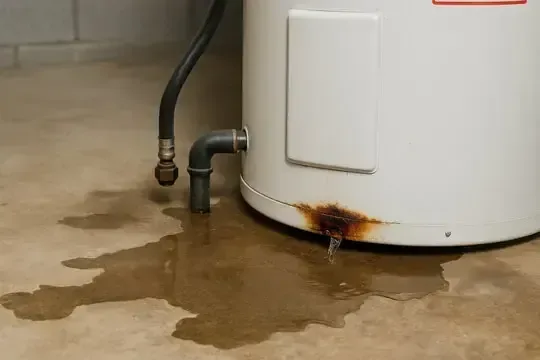
Norco had 7,057 households in the 2020 Census, with an average household size of 3.15, and a household that size keeps a hot water tank working hard. When a tank fails, the water goes wherever the floor lets it.
Key takeaways
- The tank's location, whether garage, closet or utility room, decides where the water goes and what it reaches.
- The first moves are to shut off the cold supply to the tank and the power or gas to the heater, then clear the floor.
- Water can run under walls into the next room, so readings are taken beyond the visible puddle.
- A leaking tank is replaced, not patched, and the cleanup and the replacement are separate jobs.
- Photos and a note of when the leak was found help with any insurance claim.
Where the tank sits decides where the water goes
A tank holds enough water to cover a floor quickly. What it reaches depends on the room around it.
Tanks work hardest in busy households, and a failing tank rarely gives much warning. A small seep at a fitting can turn into a split in the tank wall, which releases everything inside.
Garage
Garage floors often slope toward the door, so water heads for the driveway or toward stored boxes, shelves and the base of the walls.
Cardboard soaks up water fast, so stored items are lifted first.
Hall or bedroom closet
A closet tank sits against wall framing. Water runs into wall bottoms, under baseboards and into the flooring of the next room.
Utility room
Utility rooms often share space with a washer and dryer. Water meets flooring, cabinets and the base of appliances in a small area.
Shut off first, then clear the floor
The first few steps limit how much more water reaches the floor and keep the area safe.
If the leak comes from the relief valve pipe and not the tank body, the valve or the pressure may be at fault. Either way the first moves are the same.
- Close the cold water shutoff valve on the pipe feeding the tank
- Turn off the power at the breaker for an electric heater, or the gas control for a gas model
- Lift boxes, rugs and shoes off the wet floor
- Move water toward a door or drain with a squeegee or towels
- Photograph the tank, the wet floor and any rust or corrosion
What the water reaches
A thin film on a garage slab is a very different job from water standing in a closet. The extent of the wet area, not just its depth, sets the scope.
Water wicks into anything porous. It rises into drywall and baseboards and spreads under flooring seams where a surface can look dry.
Water that moves under a wall plate can wet the flooring in the next room, so readings continue outward until the numbers drop to normal.
- The bottom of drywall in the room and the room beside it
- Baseboards, door casings and cabinet toe kicks
- Laminate, vinyl and carpet seams
- Stored cardboard, fabric and wood items
Extraction and drying steps
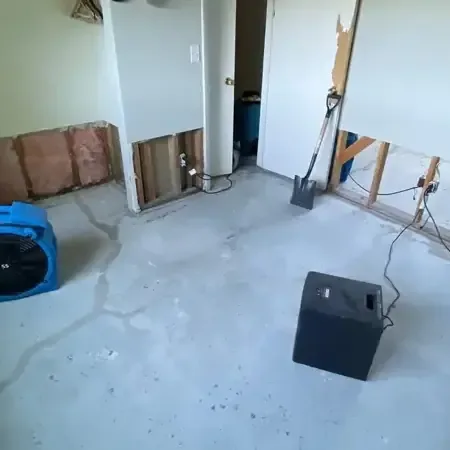
Water heater leak cleanup begins with pulling standing water out of the room. Water extraction with a truck-mounted or portable unit lifts water from slab edges, carpet and floor seams that towels cannot reach.
Wet pad and swollen baseboards that cannot recover are removed. Drywall is opened only where moisture readings call for it.
Drying equipment then runs while a technician returns to measure progress. The job is finished when readings in the affected materials match a dry reference, not when the room merely feels dry.
Air movers push dry air across wet surfaces while dehumidifiers pull moisture out of the room. Both are adjusted at each visit as the readings fall.
- Extraction of standing water and soaked fibers
- Removal of wet pad, swollen baseboards and soft board
- Drying of slab edges, wall bottoms and cabinet bases
- Moisture checks until the affected materials match a dry reference
Signs a tank is close to failing
In the 2010 Census, 81.2 percent of Norco's occupied housing units were owner-occupied and 18.8 percent were rented. Whoever lives in the home, a quick look at the tank now and then catches many failures early.
- Rust-colored water from hot taps
- A damp spot or a small puddle at the base of the tank
- A steady drip from the relief valve pipe
- Popping or rumbling sounds from inside the tank
- Corrosion around the fittings on top
Photos and notes for the claim
A claim is easier to explain with a clear record. A few habits make the difference.
Readings, photos and notes are kept together so the insurer sees the same story the drying team saw.
Receipts and invoices belong in the same folder as the photos, since an insurer often asks for both.
- Photos of the tank, the floor and the damaged items before cleanup
- A note of the time the leak was found and the time the supply was shut off
- A list of stored items that were lost or damaged
- Copies of any plumber's invoice for the tank replacement
After the dry-out: replacement and prevention
A failed tank is replaced by a plumber. The drying work and the replacement are separate jobs, and the area should be dry before a new tank is set.
A drain pan under the tank and a visible shutoff valve make the next leak easier to catch. For a wider look at local service, see water damage restoration in Norco, or the broader water heater leak cleanup service.
After the new tank is in, a quick look at the floor around it for a week or two catches any fitting that was not seated well.
Questions
What should be shut off first when a water heater leaks?
Close the cold water shutoff valve to the tank and turn off the power at the breaker or the gas control. Then lift items off the floor and start clearing water. Doing these two steps before anything else limits how much more water reaches the floor.
Can a leaking tank be repaired?
In most cases a leaking tank is replaced. A leak from a fitting or valve can sometimes be fixed, but a plumber decides which applies.
Does a garage leak cause less damage than a closet leak?
Often, because water can spread across a slab and out the door. A closet leak can soak wall framing and the next room, so readings beyond the puddle matter more. Either way, the room beyond the puddle gets checked.
How do I know the area is dry?
Moisture readings compare the affected materials to a dry reference. A floor that feels dry to the hand can still be wet inside.
Should drywall be cut out after a tank leak?
Only where readings show water inside the wall. If the board is wet only at the surface, it can sometimes be dried in place.
Should the heater be turned back on after the leak is stopped?
Not until a plumber has checked it. A leaking tank is replaced, and a heater should never run empty.