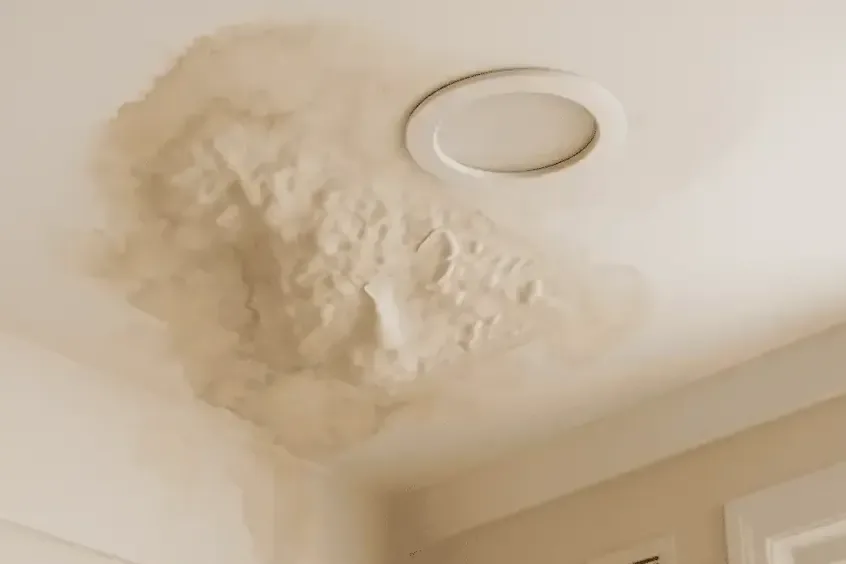
Newer communities in north Fontana mix detached homes with condominiums and townhomes, including condos at Shady Trails and Narra Hills. In a stacked or attached home, a ceiling stain can come from three places, and finding the right one comes before any repair.
Key takeaways
- A ceiling stain in a stacked or attached home comes from the roof, the air conditioner drain or the unit above.
- Timing gives clues: after rain points up, during cooling points to the drain, and with bath or laundry use points to the unit above.
- The source is traced before drywall is cut, so the right area is opened and dried.
- Neighbors and managers are part of the job in shared buildings, and notes should be shared early.
- Photos and moisture readings help both sides understand what was wet and for how long.
Three usual sources of a ceiling stain
A stain on a ceiling is a symptom, not a diagnosis. The water may have traveled across a joist bay or down a wall before it showed.
The roof
Fontana rain falls mostly from January to March after months of nearly dry weather, so a roof weak spot often shows in the first storms. Santa Ana winds blow through the Cajon Pass and can lift edges and flashing before the rain.
In attached buildings, a roof is often shared, which means a roof problem may involve more than one unit and the association.
The air conditioner drain
Fontana summers are often well over 100 degrees, so cooling runs hard. A clogged condensate drain or a full pan can overflow into a ceiling or closet.
The drain can clog with dust and algae over a long season, and the overflow often hits a closet or a hallway ceiling below the air handler.
The unit above
In a stacked building, a toilet supply, a washer hose or a bath fixture above can leak into the ceiling below. The owner of the lower unit often sees the damage first.
The water can come from a slow supply leak, a failed hose or a tub overflow, and it can run for hours before the unit above notices.
Telling the sources apart
Timing and pattern give strong hints even before anything is opened.
No single clue settles the question, so the pattern across several events counts. A short log of dates and weather is more useful than memory.
- A stain that grows after rain and stops in dry weather points to the roof
- A stain that appears near a vent or air handler during hot weather points to the drain
- A stain that grows when the neighbor showers or runs the washer points to the unit above
- A ring-shaped stain with a dark edge suggests repeated wetting
- A bubbled paint spot with soft drywall under it suggests water has been present for a while
Why tracing comes before cutting
Opening drywall in the wrong place only adds to the repair. A moisture meter, an infrared camera and a look at the attic or the unit above point to the real entry.
Once the source is found and stopped, the opening is made where readings say the material is wet. That keeps the demolition as small as possible.
An air handler pan check and a peek in the attic, when access is possible, are quick ways to rule sources in or out.
Drying the ceiling and the wall below
Water that comes through a ceiling does not stop there. It runs down inside the wall and into the floor below, so a small stain can hide a larger wet area.
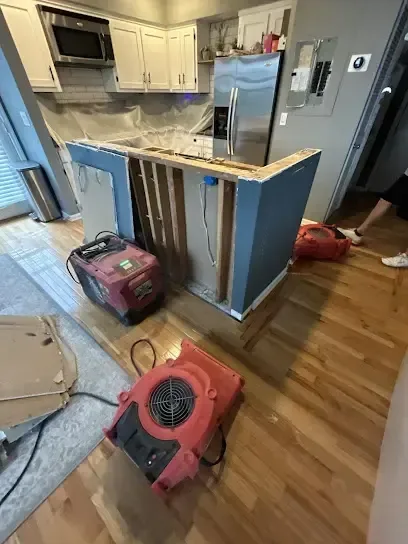
Ceiling leak water damage work cuts only what is needed, dries the joist bay and the wall, and checks the floor. Wet insulation is replaced because it holds water.
A small pocket of trapped water above a ceiling can sag a whole section. Releasing and drying that pocket first prevents a sudden drop of wet drywall.
- Ceiling drywall opened where readings say it is wet
- Insulation pulled from the wet bay
- Wall bottoms and baseboards checked below
- Flooring checked for moisture at the walls
Shared walls, neighbors and rentals
In the 2020 Census, Fontana had 54,532 occupied homes, of which 66.8% were owner-occupied and 33.2% were rented. In a shared building, that mix means the person who sees the damage is not always the person who owns the source.
AC condensate leak cleanup and other source repairs need access to the unit where the water starts. A quick, calm message to the neighbor or the manager usually speeds that up.
In a mixed community of detached homes and attached units, the same leak can be a private repair in one home and a shared one in the next.
What to document
A few notes taken early make later conversations simpler.
If a neighbor will not respond, the dated photos and readings give a property manager what is needed to act.
- Dated photos of the stain and how it changes
- The time of any rain or hot weather when it grew
- Messages with the neighbor, manager or association
- Moisture readings and the dry reference used
- A list of damaged belongings
What the cleanup includes
After the source is fixed, the drying team removes wet materials, dries what can be saved and keeps readings until the area is dry. Insulation and drywall are replaced by a repair contractor afterward.
For a wider look at local service, see water damage restoration in Fontana. The broader ceiling leak service covers the same steps in other homes.
A final moisture check confirms the ceiling, wall and floor have all returned to normal before anything is closed up.
Questions
How do I know if a ceiling stain is from the roof or the unit above?
Timing helps. A stain that grows after rain points to the roof, while one that grows with a neighbor's shower or laundry points to the unit above. Checking the attic or the air handler pan can rule out the other two.
Can an air conditioner cause a ceiling stain?
Yes. A clogged condensate drain or a full pan can overflow into a ceiling or closet, especially when cooling runs for long periods.
Who should be told about a leak from a unit above?
The neighbor or the manager should be told right away, with photos. In a shared building, early notice speeds up the repair at the source. Written notes keep the conversation clear.
Does the ceiling have to be torn out?
Only the wet part. Readings show how much drywall and insulation are wet, and the opening is kept as small as possible.
Is the damage always where the stain is?
No. Water can run along framing and down a wall, so the wet area is often larger than the stain.
Can wet insulation be left in place?
Usually not. Wet insulation holds water against drywall and framing, so it is pulled from the wet bay and replaced after drying.