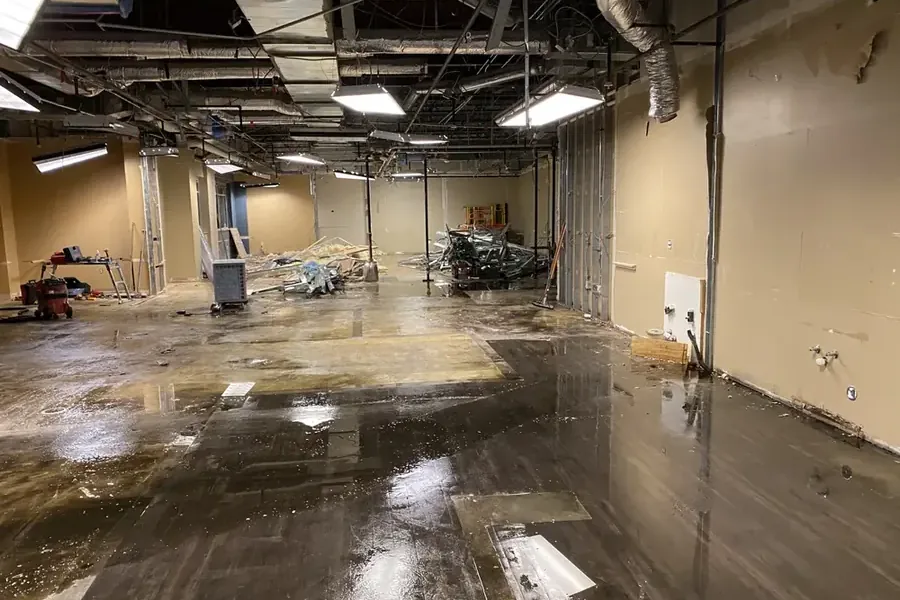
Eastvale's top employers include a fulfillment center, a distribution center, big-box retailers and the school district, according to the city's 2023 annual financial report. Buildings of that scale dry differently from a house, because they often cannot close while the water is dealt with.
Key takeaways
- Large buildings are dried in zones, so the wet area is isolated while the rest of the building keeps working.
- Mapping with moisture meters and an infrared camera comes before any equipment is placed.
- Warehouses, stores and schools each need a different plan for floors, stock and people.
- Daily readings, photos and an equipment log are the records a business owner needs for an insurer.
- Cost and timing depend on the size of the wet area, the materials involved and whether the water was clean.
Why big buildings dry differently
A warehouse or a store has a large roof, a wide slab and long runs of pipe and sprinkler supply. Water can travel a long way from the point of failure before anyone sees it.
The scale changes the job. Extraction covers more floor, drying equipment is staged in zones, and the work is planned around people, stock and schedules.
Roof leaks over a large floor can go unnoticed because ceilings are high and rooms are lit from overhead. Water often collects on the roof deck or in insulation first, then shows up at a seam or a light fixture far from the entry point.
The city's 2023 annual financial report lists an Amazon Fulfillment Center with 4,918 employees, a Walmart Distribution Center with 952 and Corona-Norco Unified School District with 755 among the top employers. Retailers such as Costco, Home Depot and Kohl's appear further down the list.
Those employers are named only as the report lists them. Nothing here says any of them has had a water loss.
Mapping the wet area first
Before any equipment is placed, the team maps where the water went. Moisture meters read floors, wall bases and ceilings, and an infrared camera highlights cool, wet patches across large surfaces.
On a big floor plate the map decides everything that follows. It sets the size of each drying zone and shows where water slipped under an interior wall or into the base of a partition.
- A sketch of the floor with each reading marked
- Notes on materials, such as concrete slab, sealed floor, carpet tile, drywall and ceiling tile
- A baseline reading from a dry area of the same building
- Photos tied to each marked area
Zones, barriers and a schedule
Once the wet area is known, it is walled off with plastic barriers or closed doors where possible. That keeps humid air and any contaminants out of the side of the building that is still working.
A schedule then sets which zones are dried first. Areas that carry the most traffic or the most stock are usually brought back first.
Power and safety are part of the plan. Cords are kept off wet floors, equipment loads are spread across circuits, and walkways are marked so staff and visitors can pass the dry zones safely.
- Containment around the wet zone, with a clear walkway for staff
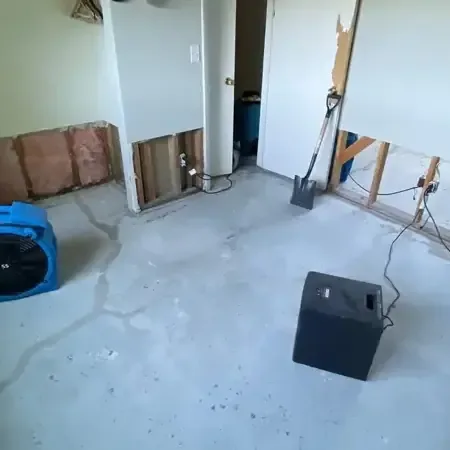
- Dehumidifiers placed so dry air moves across wet surfaces
- Air movers aimed along walls and floors, not at stock
- Readings at each visit, with equipment moved as zones dry
- A plan for noise and power draw during working hours
Three settings, three plans
The same dry-out method looks different depending on what sits on the floor.
Warehouse and distribution space
Racking, pallets and packaged stock change how air moves and how water wicks. Concrete slabs hold water longer than they look, so slab readings drive the schedule.
Stock is lifted onto plastic or relocated before extraction starts.
Where racking sits over a wet slab, readings are taken under and beside the uprights, since water collects at the base of each one.
- Forklift lanes kept clear where possible
- Dock doors checked as a path for water
- Cardboard and paper stock moved first, since it wicks water fast
Retail floors
A store has to protect displays and customers. Sales areas can often be closed in sections while the back of the building is dried first.
Fixtures, shelving and floor displays are moved to dry areas before extraction starts, and the aisles that carry the most customers are cleared of equipment first.
- Display fixtures lifted off wet flooring
- Checkout and entry areas dried first so the store can reopen in sections
- Wet ceiling tile replaced because it will not recover
School buildings
Classrooms, hallways and gyms have to be safe and dry before students return. Carpet, ceiling tile and cabinets are checked room by room, and readings are kept for the district.
- Classroom carpet and cabinets checked room by room
- Hallways and exits cleared of cords and hoses
- Gym floors read slowly, since wood and sealed surfaces trap moisture
Records a business owner needs
A business owner often has to explain a loss to an insurer, a landlord or a property manager. Clear records speed up those conversations.
Many owners also keep a short daily note about what was dried, what was moved and what still needs attention. It turns a long project into a clear timeline.
- Photos of the failure point and of each affected area before cleanup
- Daily moisture readings and the dry reference they were compared with
- An equipment log with placement and removal dates
- A list of removed materials and stock
- Notes on lost work hours, if the insurer asks for them
Cost and timing questions
No single number fits a large building. Cost and timing depend on the size of the wet area, the materials involved and whether the water was clean or contaminated.
Clean water from a failed supply pipe can often be dried in place. Water that is contaminated, such as sewage or runoff, brings removal of porous materials and a larger scope.
A commercial water damage plan starts with the map and a written scope. Structural drying then runs until readings reach the target for each zone.
For a wider look at local service, see water damage restoration in Eastvale. The broader commercial water damage service covers the same process in other buildings.
Early signs of a hidden leak in a large building
Large buildings hide leaks well, so facilities staff watch for small signals.
- Stained or sagging ceiling tiles
- Floors that buckle, peel or feel soft
- A musty smell in a corner that was dry before
- Warm, humid air in one section of the building
- Condensation on windows or walls with no clear cause
Questions
Can a business stay open during drying?
Often in part. The wet zone is isolated and dried in phases while the rest of the building keeps working, though noise, equipment and walkways need planning. Daily check-ins keep managers aware of where equipment sits and which zone is next.
How is a large floor dried?
The wet area is mapped, walled into zones and dried with dehumidifiers and air movers placed to move dry air across the surface. Readings at each visit show when a zone can be released. A sealed concrete floor can look dry on top while the slab still holds water, which is why readings matter more than touch.
Is clean water treated the same as contaminated water in a business?
No. Clean supply water is dried in place where materials allow, while contaminated water means removal of porous materials and cleaning before drying.
What records does an insurer expect?
Photos of the damage, daily moisture readings, an equipment log and a list of removed materials and stock. Keeping them together makes a claim easier to explain.
Do school buildings need special handling?
Occupancy and safety set the schedule. Walkways must be safe and classrooms dry before students return, and readings are kept for the district.
What happens to inventory in a wet area?
Stock is lifted off the floor or moved to a dry zone before extraction. Cardboard and paper items that already absorbed water are usually discarded, while sealed or plastic-wrapped goods may be saved.