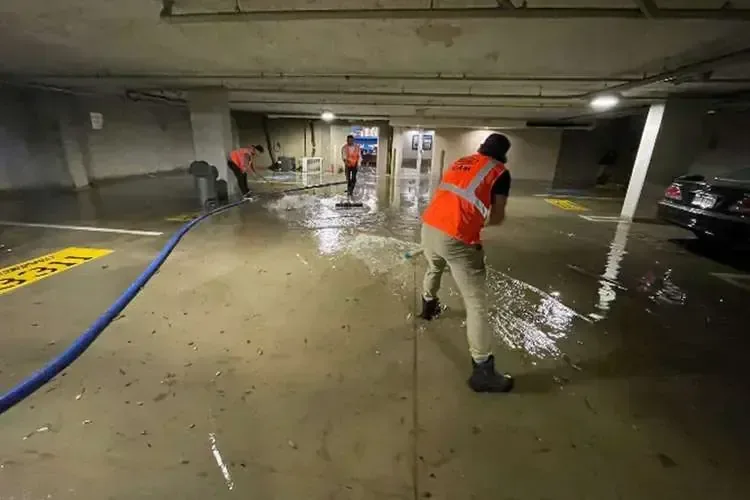
About 20 Claremont homes had unexplained flooding on their property over one week, and residents ran portable pumps, according to a CBS Los Angeles report from April 2023. When water appears and no one can say where it came from, the first job is to protect the house and record what is happening, not to solve the mystery.
Key takeaways
- Water on the ground outside and water inside the house call for different first moves, so separate them early.
- A portable pump moves bulk water but leaves wet pad, baseboards and wall bottoms behind.
- Photos with times, plus a pencil mark at the edge of the wet area, give the later work a clear starting record.
- Until the source is known, treat the water as possibly contaminated and keep people and pets out of it.
- Moisture readings, not appearance, show where the water went and when the structure is dry.
What the Claremont report described
CBS Los Angeles covered a neighborhood where about 20 homes had unexplained flooding on their property over a single week. Residents ran portable pumps to keep the water back.
This post claims no cause for that event. It speaks to the situation any owner faces when water turns up without a clear source: what to do, what to record and what to hand a drying team.
Golden State Water supplies the city's drinking water from local groundwater, and Sustainable Claremont describes local water as in short supply. Neither fact explains a flooded yard, but both are reasons to keep careful notes on when and where the water showed up.
Water that arrives from the ground or from beside a house behaves differently from a roof leak. It runs to the lowest ground first, pools against doors, garage thresholds and slab edges, and then works in wherever there is a gap.
Separate outside water from inside water
The two problems can share one puddle, but they do not share one plan.
Water on the ground outside
Water in a yard or against a foundation is a threat to the house, not yet damage to it. The aim is to keep it from crossing the threshold.
A pump set in a low corner of a yard can also draw water toward itself from a wide area. That helps while the pump runs, but water often returns if the source is still active.
- Note where the water enters the lot and where it collects
- Lift vehicles, stored boxes and electronics onto higher ground
- Aim pump discharge away from the house and away from a neighbor's wall
- Photograph the water level against something fixed, such as a step or a fence post
Water that has reached a floor
Once water sits on flooring, the materials start to absorb it. Carpet pad, baseboards, drywall bottoms and cabinet toe kicks wick moisture upward and sideways right away.
At that point a pump alone is not enough, because the wet part of the house is no longer just the surface.
Record the water before moving anything
A clear record helps the drying team, and it helps an insurer understand what happened. It takes only a few minutes with a phone and a pencil.
Notes made in the moment are more reliable than memory a week later. A simple running log of times, water depth and what was done keeps the story straight for everyone who touches the job afterward.
Do not discard wet items until they have been photographed. Items that can be dried may be saved, and the photos protect the ones that cannot.
- Wide photos of each room, then close photos of the high-water mark on walls and furniture
- A pencil mark at the edge of the wet area on flooring or drywall, with the time written beside it
- A short list of damaged items, with brand and rough age if known
- A note of when the water was first seen and whether it is rising, steady or falling
- Photos of any visible source, such as a wet slope, a gap in a wall or a hole in the ground
Portable pumps and truck-mounted extraction
A portable pump is a sensible first tool for deep standing water in a yard or garage. It moves bulk water, but it leaves the pad, carpet fibers and wall bottoms soaked.
Extraction equipment made for building interiors pulls water out of carpet, pad and flooring seams, which a yard pump cannot do. Water extraction and removal is the step that comes before any real drying.
If a pump has to keep running all night, that is a sign the water is still arriving. It is also a reason to write down where the discharge hose runs.
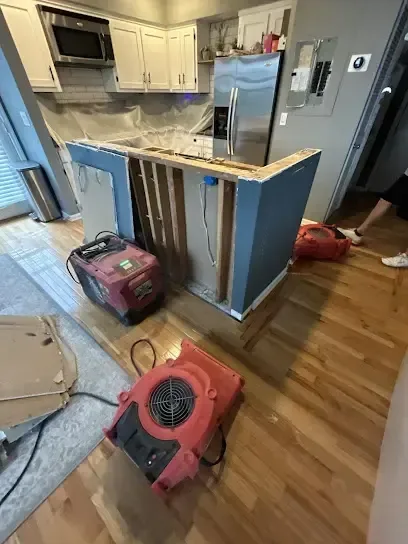
Some water ends up under flooring or inside a wall cavity, where a pump cannot reach it. Specialized extraction tools and small access holes are used for those spots, and the choice depends on readings rather than guesses.
Treat water of unknown origin as contaminated
Clean supply water is the best case. Water that has crossed soil, a yard or a drain is handled as Category 3 until its source is known.
That choice affects what happens to carpet, pad and low drywall. Storm runoff and flood cleanup follows the same contaminated-water rules, even when no storm is involved.
- Keep children and pets out of the wet area
- Wear boots and gloves when walking through it
- Skip box fans and household vacuums, which can spread contamination
- Leave wet outlets and appliances alone until power can be cut from a dry spot
Finding where the water went
Water travels farther than it looks. It slips under baseboards, into the bottoms of walls and under cabinets, where the surface can seem dry.
A moisture meter and an infrared camera map the wet area, and readings are taken again at each visit to track progress. Structural drying and dehumidification continues until the affected framing and drywall read close to an unaffected reference spot in the same home.
Hardwood, laminate and engineered flooring can cup or lift when water gets beneath them, so they get special attention. Cabinets are checked at the base, since a toe kick can hide a wet cavity.
A drying time estimator can give a rough range before the readings are in.
Who else to ask
Because the source is unclear, a few outside questions are worth asking early. Each answer narrows the cause, but none replaces getting standing water out of the house.
- Ask the water utility whether a supply problem is known in the area
- Ask neighbors whether water has shown up on their lots too, and compare times
- Ask a plumber to check the home's own supply pipes and meter for movement
- Tell the insurer that water arrived from an unknown source, and send the photos
Questions
Is a portable pump enough for a flooded yard?
For standing water outside, a pump moves bulk water. Once water has reached floors or walls, pump work is followed by extraction and drying, because wet pad and wall bottoms stay wet on their own.
Should water with an unknown source be treated as dirty?
Yes. Until the source is known, the cautious assumption is Category 3, which means protective gear, no fans and removal of porous materials that cannot be cleaned.
How soon should drying start?
As soon as the standing water is out. Many wet materials begin to turn within 24 to 48 hours, and that includes the risk of mold, so delay usually costs more than it saves.
What should be photographed first?
Start with wide shots of each room and the high-water mark, then close shots of the lowest wet materials and any visible source. Time stamps on the photos matter.
Does the cause have to be found before cleanup begins?
No. Cleanup and drying protect the house while the cause is still being sorted out. Readings, photos and notes are kept so the insurer has a clear record if the cause comes out later.
Can wet drywall be saved?
Sometimes. If the water was clean and the drywall was not soaked for long, it can be dried in place. If the water was contaminated, or the board has swollen, softened or crumbled, it is cut out and replaced.